
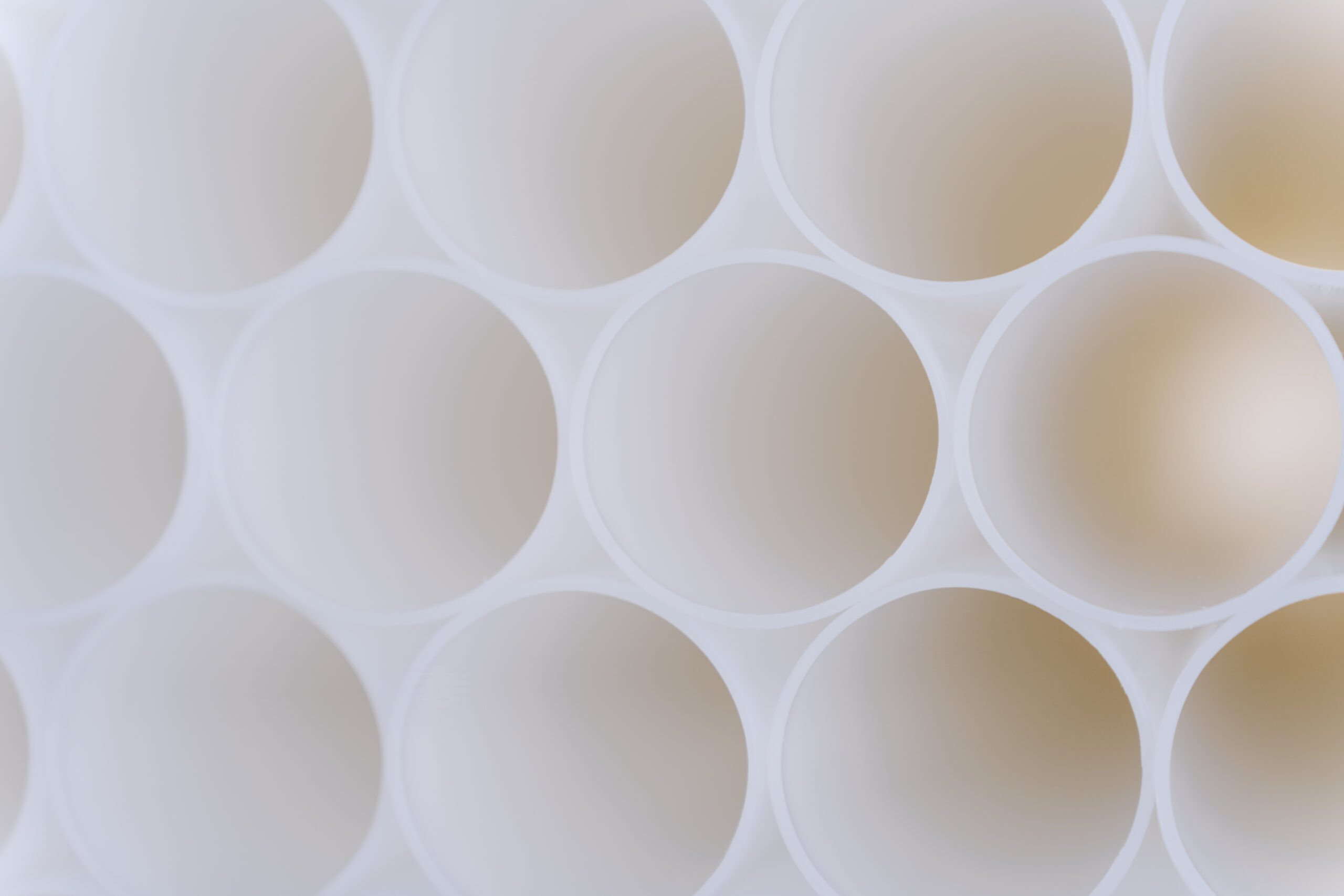
In this process, the plastic material is melted inside the extruder and then forced through a die head with the shape of the tube to be manufactured. This die head is mainly composed of two parts: the die, which defines the outer diameter, and the mandrel, which determines the inner diameter and, therefore, the wall thickness of the tube.
The combination of the die and the mandrel is one of the most important elements of the process, as it has a direct impact on the final quality of the product. A correct configuration makes it possible to obtain tubes with stable dimensions, a good surface finish and uniform wall thickness.
After leaving the die head, the tube goes through a calibration and cooling stage. The calibrator helps maintain the desired diameter while the material cools down and gains dimensional stability. Cooling can be carried out using a water bath or a water spray system.
Water baths are commonly used in many tube extrusion processes, while spray systems are often used for larger-diameter tubes or in applications where cooling needs to be controlled more precisely. In general, the larger the tube diameter, the lower the extrusion speed tends to be, as the material requires more time to cool properly.
Once cooled, the tube moves along the line through a haul-off system. This can be done using belts, caterpillar haul-offs or rollers, depending on the diameter, material rigidity and product characteristics. Its main function is to maintain a constant speed in order to avoid wall thickness variations or deformation during the process.
Finally, the tube reaches the cutting system. Cutting can be performed using a guillotine, radial saw or planetary saw. The choice of system mainly depends on the tube diameter, wall thickness, type of material and the required cutting quality.
Single-screw or twin-screw extruders can be used for plastic tube manufacturing, depending on the material and process requirements. Materials such as polypropylene, polyethylene, PVC or polystyrene may be used depending on the final application, the required mechanical properties and the conditions of use of the product.
In short, quality in plastic tube extrusion does not depend only on the material used, but also on the correct coordination of all the elements of the line. Proper control of the die head, calibration, cooling, haul-off and cutting systems makes it possible to obtain more precise, stable tubes adapted to each customer’s requirements.
At SCT-STRAW, we manufacture extruded plastic tubes, adapting to each customer’s technical requirements in terms of dimensions, materials, colours and finishes. Contact us to discuss your project and find the most suitable solution for your application.