
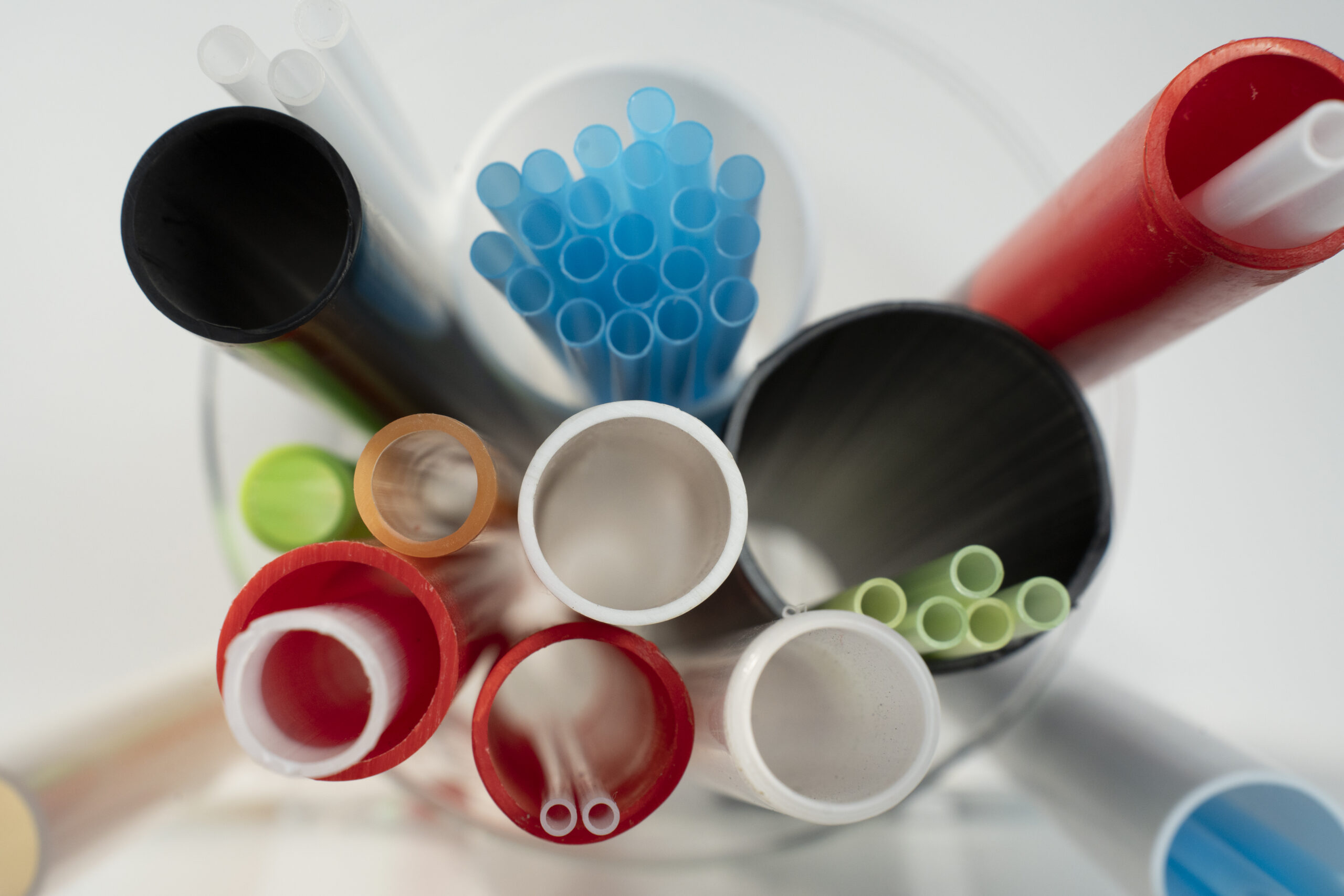
What products are made by extrusion?
Almost anything that is long and has the same shape along its entire length can be made by extrusion, as well as some short parts that follow the same rule.
Some examples are:
- Tubes for fluids or cables.
- Plastic profiles for doors, windows, furniture o automotive.
- Sticks and rods, like lollipop sticks.
In extrusion, different types of plastic are used depending on the final application:
- PVC (polyvinyl chloride): widely used in profiles and technical tubes.
- PP (polypropylene): lightweight and suitable for many food applications, such as candy sticks.
- PE (polyethylene): common in flexible tubes and films.
- PS (polystyrene): for profiles and rigid parts.
- PA (polyamide or nylon): when higher mechanical strength is needed.
- TPE / TPV (thermoplastic elastomers): ideal for seals and flexible parts.
Each one provides different properties: rigidity, flexibility, chemical resistance, food suitability, etc.
Colors in extrusion: aesthetics, identification, and performance.
In extrusion, color is not just a visual decision; it can also be used to identify lines, circuits, or part numbers, reinforce branding, and, in some cases, improve product performance. Color is usually added through masterbatch (a pigment concentrate), which makes it possible to achieve anything from solid tones to translucent or natural finishes.
It’s important to keep in mind that color can affect material properties.
